

Enhancing the Travel Industry with Flutter Apps: Techno Softwares Explains
In recent years, the travel industry has undergone a significant transformation, largely driven by technological advancements. As we navigate through this digital age, we find ourselves increasingly reliant on mobile applications to enhance our travel experiences. Among the various frameworks available for app development, Flutter has emerged as a powerful tool that is reshaping how travel businesses operate.
Developed by Google, Flutter allows for the creation of natively compiled applications for mobile, web, and desktop from a single codebase. This capability is particularly appealing to travel companies looking to streamline their operations and improve customer engagement. As we delve deeper into the world of Flutter apps, we recognize their potential to revolutionize the travel sector.
With its rich set of pre-designed widgets and a highly customizable interface, Flutter enables developers to create visually stunning and highly functional applications. This is especially important in the travel industry, where user experience can significantly influence customer satisfaction and loyalty. By harnessing the power of Flutter, travel businesses can not only enhance their service offerings but also create a more cohesive and engaging experience for travelers.
Key Takeaways
- Flutter apps offer a versatile and efficient platform for travel businesses to engage with their customers and provide seamless booking and planning experiences.
- The advantages of using Flutter apps for travel businesses include cost-effectiveness, faster development time, and cross-platform compatibility.
- Flutter apps improve user experience in travel by offering smooth and responsive interfaces, real-time updates, and personalized recommendations.
- Integrating features in Flutter apps for travel booking and planning can include interactive maps, secure payment gateways, and itinerary management tools.
- Case studies of successful travel businesses using Flutter apps showcase how the platform has helped them increase customer engagement, streamline operations, and boost revenue.
Advantages of Using Flutter Apps for Travel Businesses
One of the most compelling advantages of using Flutter for travel applications is its ability to reduce development time and costs. With a single codebase that works across multiple platforms, we can save valuable resources that would otherwise be spent on developing separate applications for iOS and Android. This efficiency allows us to allocate our budgets more effectively, focusing on enhancing features and improving user experience rather than duplicating efforts.
Additionally, the rapid development cycle facilitated by Flutter means that we can quickly respond to market changes and user feedback, ensuring our apps remain relevant and competitive. Another significant benefit of Flutter is its performance. Unlike other cross-platform frameworks that may compromise on speed and responsiveness, Flutter apps are compiled directly to native code.
This results in smooth animations and quick load times, which are crucial in the travel industry where users expect instant access to information and services. Furthermore, Flutter’s hot reload feature allows us to see changes in real-time during development, enabling us to iterate quickly and refine our applications based on user testing and feedback. This agility not only enhances our development process but also leads to a more polished final product.
How Flutter Apps Improve User Experience in Travel
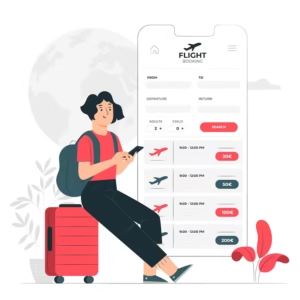
User experience is paramount in the travel industry, where customers often seek seamless interactions and intuitive navigation. Flutter’s rich set of customizable widgets allows us to design applications that are not only visually appealing but also user-friendly. By leveraging these widgets, we can create interfaces that guide users effortlessly through the booking process, from searching for flights or accommodations to making payments.
The ability to tailor the user interface to meet specific needs ensures that we can cater to diverse traveler preferences, ultimately enhancing satisfaction. Moreover, Flutter’s support for animations and transitions adds an extra layer of engagement to our applications. We can create dynamic experiences that captivate users’ attention and make interactions feel more natural.
For instance, incorporating smooth transitions between screens or animated elements during loading times can significantly improve how users perceive our apps. By focusing on these details, we can foster a sense of delight and excitement among travelers, encouraging them to return to our applications for future bookings.
Integrating Features in Flutter Apps for Travel Booking and Planning
To truly stand out in the competitive travel market, we must integrate features that cater to the specific needs of travelers. Flutter’s flexibility allows us to incorporate a wide range of functionalities into our apps. For instance, we can integrate real-time flight tracking, personalized recommendations based on user preferences, and interactive maps that help users navigate their destinations.
These features not only enhance the overall user experience but also provide travelers with valuable information at their fingertips. Additionally, we can implement social sharing capabilities within our Flutter apps, allowing users to share their travel experiences with friends and family effortlessly. This not only promotes our brand but also encourages word-of-mouth marketing, which is invaluable in the travel industry.
By creating a community around our app, we can foster loyalty among users who feel connected to our brand and are more likely to choose us for their future travel needs.
Case Studies of Successful Travel Businesses Using Flutter Apps
Several travel businesses have successfully adopted Flutter to enhance their services and improve customer engagement. One notable example is a popular travel booking platform that utilized Flutter to revamp its mobile application. By transitioning to Flutter, they were able to reduce their development time by nearly 50%, allowing them to launch new features more rapidly.
The result was a significant increase in user retention rates as customers appreciated the app’s improved performance and user-friendly interface. Another case study involves a travel agency that focused on personalized travel planning. By leveraging Flutter’s capabilities, they developed an app that offers tailored itineraries based on user preferences and past travel history.
The app’s ability to provide real-time updates on flight statuses and local attractions has made it an indispensable tool for travelers. As a result, this agency has seen a marked increase in customer satisfaction and repeat business, demonstrating the tangible benefits of adopting Flutter in the travel sector.
Challenges and Solutions in Developing Flutter Apps for the Travel Industry
While the advantages of using Flutter are clear, we must also acknowledge the challenges that come with developing applications in this framework. One significant hurdle is ensuring compatibility with various devices and operating systems. Although Flutter aims for cross-platform functionality, discrepancies can arise due to differences in hardware capabilities or operating system versions.
To mitigate this issue, we must conduct thorough testing across multiple devices to ensure a consistent experience for all users. Another challenge lies in integrating third-party services such as payment gateways or booking systems into our Flutter apps. While many popular services offer SDKs compatible with Flutter, some may require additional workarounds or custom solutions.
To address this challenge, we can leverage community resources and documentation available through the Flutter ecosystem. Engaging with other developers who have faced similar issues can provide valuable insights and solutions that streamline our integration processes.
Future Trends and Innovations in Flutter Apps for Travel
As we look ahead, it is clear that the future of Flutter apps in the travel industry is bright. One emerging trend is the incorporation of artificial intelligence (AI) and machine learning (ML) into our applications. By utilizing these technologies, we can offer personalized recommendations based on user behavior and preferences, enhancing the overall travel experience.
For instance, AI-driven chatbots can provide instant customer support within our apps, addressing queries and concerns in real-time. Additionally, as augmented reality (AR) technology continues to evolve, we foresee its integration into travel apps developed with Flutter. Imagine being able to use our smartphones to visualize hotel rooms or explore tourist attractions before making a booking decision.
This immersive experience could significantly influence travelers’ choices and enhance their overall satisfaction with our services.
The Impact of Flutter Apps on the Travel Industry
In conclusion, the impact of Flutter apps on the travel industry cannot be overstated. As we have explored throughout this article, Flutter offers numerous advantages that enable us to create high-quality applications that enhance user experience while streamlining development processes. From reducing costs and improving performance to integrating innovative features that cater to travelers’ needs, Flutter has proven itself as a valuable asset for travel businesses.
As we continue to embrace technological advancements and adapt to changing consumer expectations, it is essential for us to stay ahead of the curve by leveraging tools like Flutter. By doing so, we position ourselves not only as leaders in the travel industry but also as pioneers of exceptional customer experiences that will shape the future of travel itself. The journey ahead is filled with opportunities for growth and innovation, and we are excited to be part of this transformative era in travel technology.
In the context of enhancing the travel industry through innovative technologies, it’s worth exploring how cloud computing is playing a pivotal role alongside mobile development frameworks like Flutter. Techno Softwares provides an insightful exploration into this integration in their article on cloud computing. The article discusses how cloud technology can scale, secure, and streamline data operations, which complements the capabilities of Flutter apps in providing robust, scalable solutions for the travel sector. For a deeper understanding of how cloud computing can revolutionize travel applications, you can read more on their website here.
FAQs
What is Flutter?
Flutter is an open-source UI software development kit created by Google. It is used to develop applications for mobile, web, and desktop from a single codebase.
How can Flutter enhance the travel industry?
Flutter can enhance the travel industry by providing a platform to develop high-quality, cross-platform apps that offer a seamless user experience. These apps can include features such as real-time flight and hotel booking, itinerary management, and travel guides.
What are the benefits of using Flutter for travel apps?
Using Flutter for travel apps offers benefits such as faster development time, a single codebase for multiple platforms, a rich set of customizable widgets, and a smooth and native-like performance.
How can Techno Softwares help in enhancing the travel industry with Flutter apps?
Techno Softwares is a software development company that specializes in creating custom Flutter apps for the travel industry. They can help in developing feature-rich and user-friendly travel apps that cater to the specific needs of travel businesses and their customers.


